
6.1 KiB
6.1 KiB
type:: REVIEWS title:: @Recommending scholarly articles to monitor COVID-19 trends in social media based on low-cost topic modeling pages:: 11 item-type:: journalArticle original-title:: Recommending scholarly articles to monitor COVID-19 trends in social media based on low-cost topic modeling language:: en authors:: Houcemeddine Turki, Mohamed Ali Hadj Taieb, Mohamed Ben Aouicha library-catalog:: Zotero links:: Local library, Web library status:: DONE
- [[Abstract]]
	- During the last years, many computer systems have been developed to track and monitor COVID-19 social network interactions. However, these systems have been mainly based on robust probabilistic approaches like Latent Dirichlet Allocation (LDA), Embeddings, and Deep Learning. Such approaches cannot be easily debugged and enhanced to achieve better accuracy rates and usually require advanced computer infrastructures that need lots of energy and money to be maintained. In this research paper, we propose to modify LDA by letting it be driven by knowledge resources and we demonstrate how we can apply our topic modeling method to local social network interactions about COVID-19 to generate precise topic clusters reflecting the social trends about the pandemic at a low cost. Then, we outline how terms in every topic cluster can be converted into a search query to generate scholarly publications from PubMed Central for adjusting COVID-19 trendy thoughts in a considered population.
- [[Attachments]]
	- [Turki et al. - Recommending scholarly articles to monitor COVID-1.pdf](zotero://select/library/items/59BGRZB6) {{zotero-imported-file 59BGRZB6, "Turki et al. - Recommending scholarly articles to monitor COVID-1.pdf"}}
-
 {:height 191, :width 331}
-
HIGHLIGHTS
- ((6305cf53-e448-46d8-9532-2ad8c8e3c5c6))
- It's not clear what they want to say here.
- ((6305cff4-58ab-4f47-9612-7cf834d839c0))
- THAT'S THE PROBLEM/CONTEXT
- ((6305d395-86ef-46f1-8339-217410c8196d)) #card #economy id:: 65c8d454-38d0-4553-a2a1-360983da2c9c
- ((6305d38a-eb02-4493-aabc-cf3fc5e2766a)) #card #economy id:: 65c8d454-c8d8-475d-ad9f-8a671538199b
- ((6305d3ed-5202-414d-97f1-340f60e54f49)) #card #economy card-last-interval:: -1 card-repeats:: 1 card-ease-factor:: 2.5 card-next-schedule:: 2023-01-05T23:00:00.000Z card-last-reviewed:: 2023-01-05T19:56:27.675Z card-last-score:: 1 id:: 65c8d454-aa68-4e6b-b054-01272a6ff7c2
- ==topic modeling of the topics of interest related to the ongoing disease outbreak for a local population at a low cost.==
- THAT'S THE GOAL
- ((6305d9bd-078e-437c-9f9a-46e021bd81fd))
- ==So topic modeling and a recommendation system to recommend publications that are online available on PubMed Central== ???
- The underlying context seems to be ((6305da89-3e00-4430-a18b-162b01ef5641))
- ((6305dae5-07ce-484d-b114-0bcf157e9ba2)) #card #socialnetwork #datamining id:: 65c8d454-2d2b-4f79-9562-c75144838378
- ((6305db83-55fc-464f-b75b-0c6f41a8a6e1)) #infodemic #socialnetwork #datamining
- ((6305dc69-e0cd-4b66-a5e8-88d5c7501aac)) #fakenews
- ((6305dd07-642a-40b0-99d6-e41f81a6ff96))
- ==TRENDY TOPICS FOR USERS AND THUS RECOMMEND RELEVANT SCIENTIFIC ARTICLES==
- Despite the variety of scholarly publication recommender systems, quite all of them propose further readings based on the interests of a particular user and not of a global social community.
- That's important!!!!
- ((6305e133-a2df-4a47-9b9a-0f94b6359003))
- CONCERN: It's not clear how COVID related posts have been identified. background-color:: #793e3e
- ((6305e0df-6c94-4827-b5c6-d03c4d36d1bb))
- CONCERN: I see a problem of identity management here. Essentially you have to identify the same users over different social networks.
- ((6305e20e-14a7-40eb-8dda-4da889cd84be))
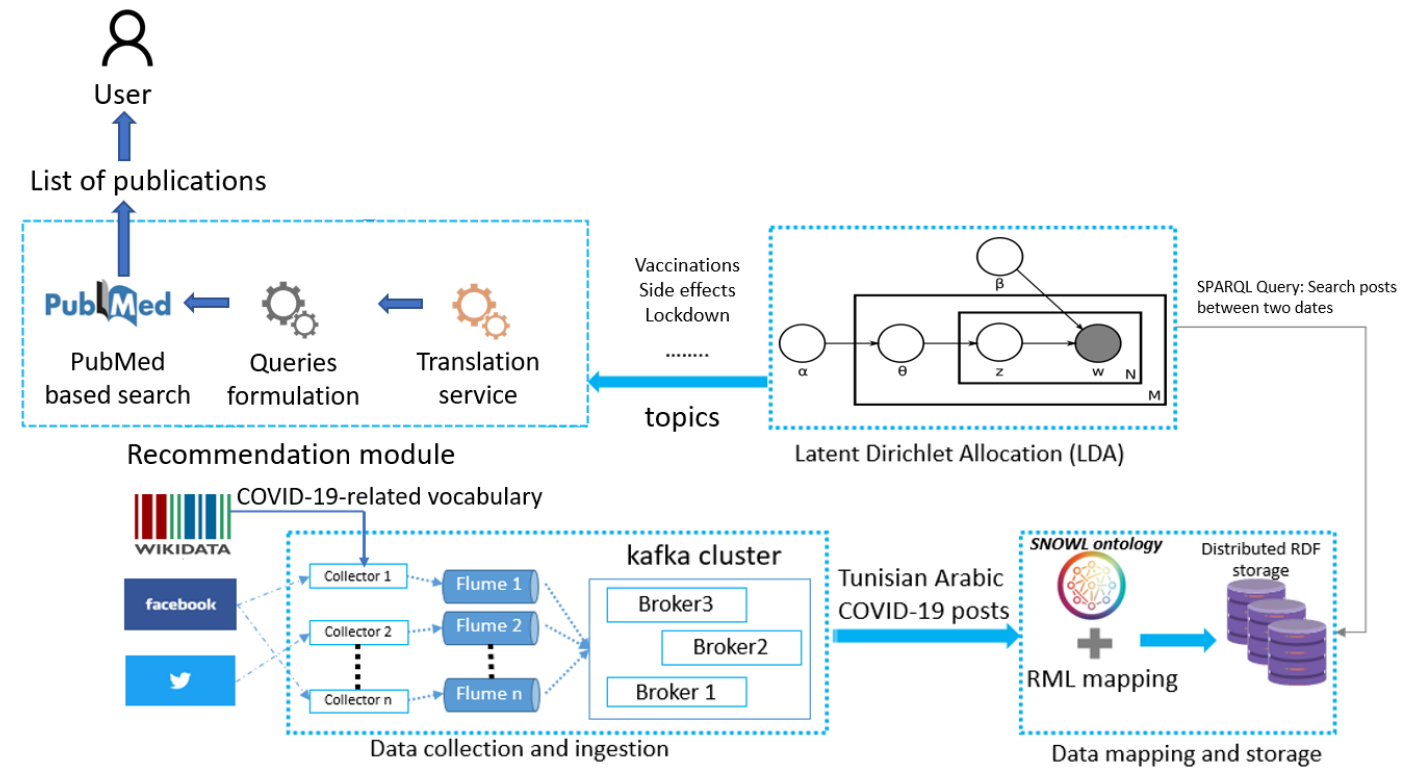
- CONCERN: According to the shown architecture, users are recommended with a list of publications, even though users are not given as input. I was expecting that the list of recommended publications are relevent for the user, who thus should be taken into account to retrieve the recommended items, isn't it?
- ((6305cf53-e448-46d8-9532-2ad8c8e3c5c6))
-
REVIEW
- The paper presents an approach to automatically recommend scientific articles related to COVID-19 relevant to the Tunisian context. Publications are recommended by mining data from different sources, i.e., Facebook, Twitter, and PubMed Central.
- The paper is about an interesting topic even though it is affected by several issues related to the following aspects, which need to be clarified:
- The role of mining social network data to recommend publications is not clear. To make this aspect evident, authors should retrieve data from PubMed Central with and without mining social network data and then discuss the relevance of the different recommendations
- Concerning the approach presented in Sec. 4, it is not clear how authors manage the problem of identity management. In particular, as far as I understood, the proposed approach can identify the same users over different social networks. This is not an easy problem, and I would have liked to see some more details about that.
- According to the architecture shown in Fig. 1, users are recommended with a list of publications, even though user profiles are not taken as input. I was expecting that the list of recommended publications should be relevant for the users asking for recommendations. How can such relevance be achieved if users are not considered as part of the input?
- Even though this is a workshop paper, authors should draw the preliminary research questions they plan to answer with the planned experiments. Even the experiment settings should be described to clarify the role of what is described in Sec. 4.1 and 4.2.
- I think the paper abruptly ends without clearly presenting and concluding the work done to meet the goal presented earlier in the paper, i.e., topic modeling for sets of users and recommending scientific articles accordingly.
